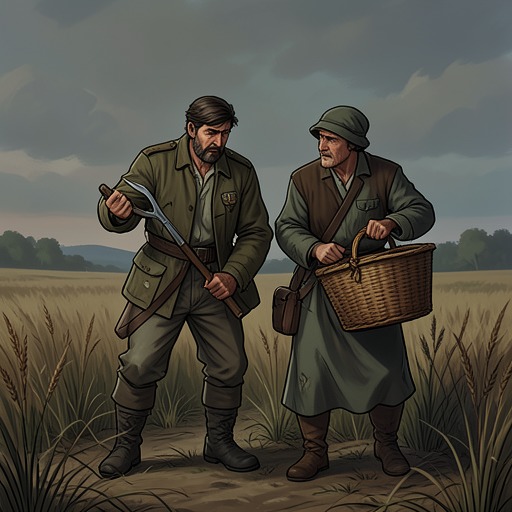
Berta of Idemo
The EmigrantsBerta of Idemo is a healer and experienced source of practical counsel whose influence reaches from Kristina’s youth into the Nilsson family’s emigration. Having once treated Kristina’s gangrene-infected knee, she has earned Kristina’s confidence; on the eve of the sea crossing, she uses that trust to prepare Kristina for dangers at sea and in the unfamiliar country ahead. Her role is both protective and unsettling: her detailed advice offers remedies, while its catalogue of possible illness makes the hazards of departure harder to ignore.
Identity and Connection to Kristina
Berta’s importance in Kristina’s life began before the emigration. After Kristina injured her knee in a fall from a swing at her family home in Duvemåla, she went to Berta in Idemo seeking a cure for gangrene. In Kristina’s later understanding, that injury and the treatment that followed set in motion the chain of events through which she met Karl Oskar and became his wife. Berta is therefore not merely an adviser encountered at departure: she belongs to the remembered beginning of Kristina’s marriage and family.
That history gives Berta particular authority when she visits Korpamoen to counsel Kristina. Kristina listens because Berta had helped her before, and the relationship is grounded in remembered practical care rather than abstract expertise. Yet Berta’s experience and confidence do not make her counsel infallible. The novel preserves both the value of her attentiveness and the limits of the knowledge she passes on.
Preparing for the Voyage
Berta warns Kristina that seasickness may affect married women especially badly, though she cannot explain why. She speculates that marriage might alter a woman’s bodily condition and make her more susceptible to the sea. Her account combines inherited seafaring knowledge—her father had gone to sea—with folk explanation: she gives Kristina a small skin pouch containing camphor to wear around her stomach, and recommends daily spoonfuls of oat porridge. She also advises taking vinegar to freshen drinking water that might become stale during a long passage.
Her preparations address ordinary bodily troubles as well as seasickness. Berta recommends pepper brännvin for diarrhea and warns Kristina to guard against both diarrhea and constipation, presenting regular attention to digestion as essential to a seafarer’s health. She recounts reports of severe intestinal illness after arrival in North America and describes pepper mixed into brännvin as a remedy. This advice reflects the emigrants’ uncertainty about what awaits them: Berta is preparing Kristina not just for the crossing, but for the bodily demands of settlement after landing.
Berta also discusses wounds and accidents in the new country. She warns that children running barefoot might encounter poisonous snakes or insects, and recommends dry camphor for snake-bite wounds. For other fresh wounds she advocates warm urine as a cleansing and healing ointment, and for a wound that might become gangrenous she tells Kristina to scrape it twice daily with a clean, sharp knife. Broken limbs, she says, should be placed in splints promptly and firmly. The guidance is specific and rooted in practical tradition, but its accumulating list of hazards makes the journey’s risks vivid to Kristina.
A Trusted Adviser, Not an Infallible One
Berta’s authority also shapes Kristina’s understanding of pregnancy. She has told Kristina that women do not become pregnant while nursing, drawing on her own experience of nursing each of her children for three years and becoming pregnant soon after she stopped. Kristina is nevertheless pregnant while still suckling her youngest child. Berta’s rule has not held in this instance; she had allowed for the possibility, adding that a man’s exceptionally potent seed might defeat prevention. The episode shows the intimacy and limits of Berta’s knowledge: her advice is rooted in experience, but experience cannot guarantee an outcome.
For Kristina, Berta’s failed prediction is consequential because she had feared another pregnancy and had been relying on what Berta told her. Kristina’s discovery comes amid anxiety about the voyage and the responsibility of taking her children across the ocean. Berta does not make that decision for her, but her counsel becomes part of the practical and emotional framework through which Kristina assesses what may happen to her body and family.
Warning and the Limits of Reassurance
Berta brings a newspaper account to Korpamoen reporting the loss of the emigrant schooner Betty Catharina. The ship had left for New York with seventy emigrants and had been missing for nearly a year. Kristina reads that among the passengers were twenty-five women and twenty children. The news transforms a general fear of ocean travel into a particular image of families who never reached their destination. Kristina worries that taking her own children onto a fragile vessel may endanger lives entrusted to her care, and wonders whether the report is a final warning from God before departure.
The contrast between Berta’s generous preparation and this devastating news defines her place in the story. She can offer remedies, warnings, and information, but cannot make the crossing safe or settle Kristina’s fear. Nor does the novel suggest that the lost ship’s fate is caused by any failure in Berta’s advice. Instead, her practical care coexists with a danger no household knowledge can master.
During the voyage, Kristina suffers from lice despite the emigrants’ preparations, and the crossing brings further sickness among the passengers. Inga-Lena, whom Kristina has watched grow weak through continuing illness, eventually suffers from scurvy, the sickness also called ship-sickness. Captain Lorentz recognizes the disease when he sees Kristina’s severe bleeding. These later events give context to the fears Berta had raised without turning her advice into a promise of protection: what she could provide was counsel, not control over the conditions aboard ship or the illnesses that followed. Through Berta, the novel connects the care people bring from home with the uncertainty of migration, where inherited remedies and intimate knowledge meet dangers beyond their power to prevent.